8h/wk
Time lost to status reporting
A UX case study. RegIntel pulls FDA, EMA, PMDA, CDSCO and Health Canada monitoring, submission pipelines and confidence-scored AI review into one calm surface — so pharma regulatory teams stop reconstructing compliance truth by hand.
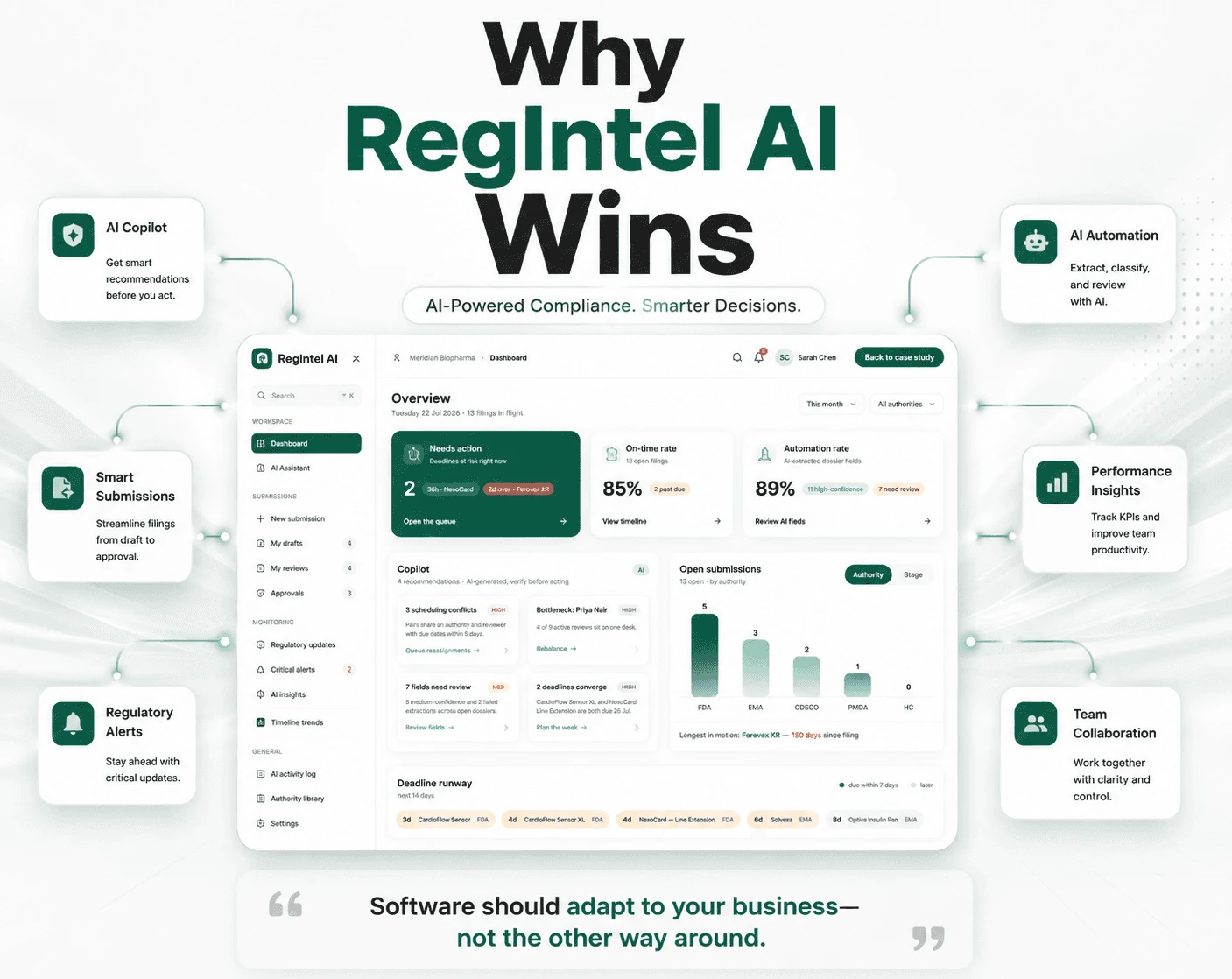
Nobody at Meridian Biopharma was careless about compliance — they simply couldn't see submissions, deadlines and authority changes in one place fast enough to act.
Deadline blindness 40+ live filings tracked by memory and one fragile spreadsheet.
Unowned monitoring Five authority portals, checked by hand, weekly at best.
Review bottlenecks Two senior reviewers held 70% of the queue, invisibly.
Audit anxiety Who-approved-what reconstructed from email threads at audit time.
AI without receipts Pilot AI tools abandoned — suggestions looked identical to facts. The core design problem.
11 days Average lag between an authority publishing a guidance change and the team discovering it applied to an active submission — the single biggest driver behind the redesign.
A VP wants portfolio altitude; a reviewer wants the next document in the queue. RegIntel serves both without becoming four separate products.
VP Regulatory Affairs RA Manager Regulatory Reviewer QA & Compliance Lead
"I don't want a status meeting. I want to know which filing is at risk in the next ten seconds."
On the line: launch dates. One missed deadline slips a launch by a quarter.
Includes: portfolio risk · deadline horizon · approval velocity
"I don't manage submissions. I manage a spreadsheet that manages submissions — badly."
✓ A deadline that finds her before she goes looking ✓ Authority changes pre-mapped to her filings ✓ AI actions she can explain to an auditor
"Every AI tool eventually asks me to trust it. I want to check it instead."
On the line: her signature. Whatever the AI drafted, her name is on the approval.
Includes: review queue · confidence scores · source traceability
"When the auditor asks who changed this and why, 'the AI did it' is not an answer."
On the line: the audit finding. One unexplainable change escalates an inspection.
Includes: AI activity log · version history · sign-off records
How might we let regulatory teams act on multi-authority change at once — while keeping every action auditable and never automating blindly?
One risk-sorted pipeline Impact-mapped monitoring Confidence-tiered AI Everything logged & reversible
Queue held by 2 senior reviewers 70%
9 interviews · 6 shadowed submission cycles · UX audit of legacy tools. One theme: consolidate first, then automate.
Stakeholder workshops RA interviews × 9 Cycle shadowing UX audit Pain-point clustering Concept validation
"Finding the current truth was the hard part — a manager kept four browser tabs open just to confirm one deadline." — field notes
Time lost to status reporting
Held by 2 senior reviewers
Suggestions trusted before redesign
The UX process moved from understanding regulatory work to testing decisions in context. Research defined the priorities before AI automation was introduced.
Discover — interview regulatory teams, shadow submission cycles, and audit the existing tools to understand how people reconstruct deadlines, ownership, and current guidance.
Define — group the friction into visibility, monitoring, review capacity, and auditability. Prioritize a single risk-sorted pipeline instead of adding another reporting layer.
Design — make authority changes traceable to affected filings, expose reviewer capacity, and use one status vocabulary across the workspace. Separate AI suggestions visually from verified data.
Prototype — connect the dashboard, monitoring, submissions, reviews, and activity log into a workflow where each suggestion shows its reason, source, confidence, and recovery action.
Test and refine — use three moderated rounds to evaluate deadline discovery, guidance triage, AI apply-and-revert, and approval tracing. The trust failure in round one shaped the later confidence and evidence treatment.
The design decisions below show why these choices survived review.
Because the fastest way to lose a regulatory team is to imply certainty. High ≥ 85% earns one-click apply; medium requires review; low renders as a question, never an action. Every apply is logged and reversible.
AI content always carries the iris tint and spark glyph — a hard rule with no exceptions. In round 1 testing, suggestions styled like facts were the #1 trust failure; the visual split moved acceptance from 12% to 73%.
Deadline risk is the question users actually have. The riskiest filing is always the first thing rendered on every screen — in testing, 'find the submission nearest its deadline' hit 98% success at 0.6 minutes.
The change lands in one monitoring feed and is auto-mapped to the active submissions it affects. Triage that needed the team's most senior expert now reads like a to-do list — the 11-day discovery lag fell to same-day.
The AI activity log is a first-class screen: every action — human or AI — records actor, reason, source and timestamp with one-click revert. In the first post-launch inspection it answered every request; audit prep fell 65%.
Calm density. Elevation comes from borders and surface contrast; shadows are reserved for overlays. IDs, dates and metrics are always IBM Plex Mono and tabular — a number is never allowed to look like prose.
From a ten-second portfolio glance down to the audit line behind a single AI suggestion.
Executive dashboard Active submissions, nearest deadlines and critical alerts — the "are we okay?" answer in one glance, riskiest filing always first. Includes: KPI cards · deadline horizon
Impact-mapped monitoring One feed for five authorities; every guidance change auto-linked to the active filings it touches. The 11-day lag, closed to same-day. Includes: authority badges · affected-filing map
✓ Always logged, always reversible ✓ Iris tint + spark glyph — never mistaken for facts
Workload-aware reviews Per-reviewer capacity visible at assignment time — the two-senior-reviewer bottleneck, dissolved into a glance. Includes: SLA timers · smart reassignment
Critical alerts Deadline breaches escalate two weeks out — never color alone; always icon, label and a next action. Includes: escalation rules · next actions
AI activity log The trust anchor: every AI action with actor, reason, source, timestamp and one-click revert. Audit prep becomes a filter, not a project. Includes: full trace · one-click revert
Five views share one sidebar, status language, and visual system.
Select a screen below to explore the interface. Open the live product at the end of this case study to try the working prototype.
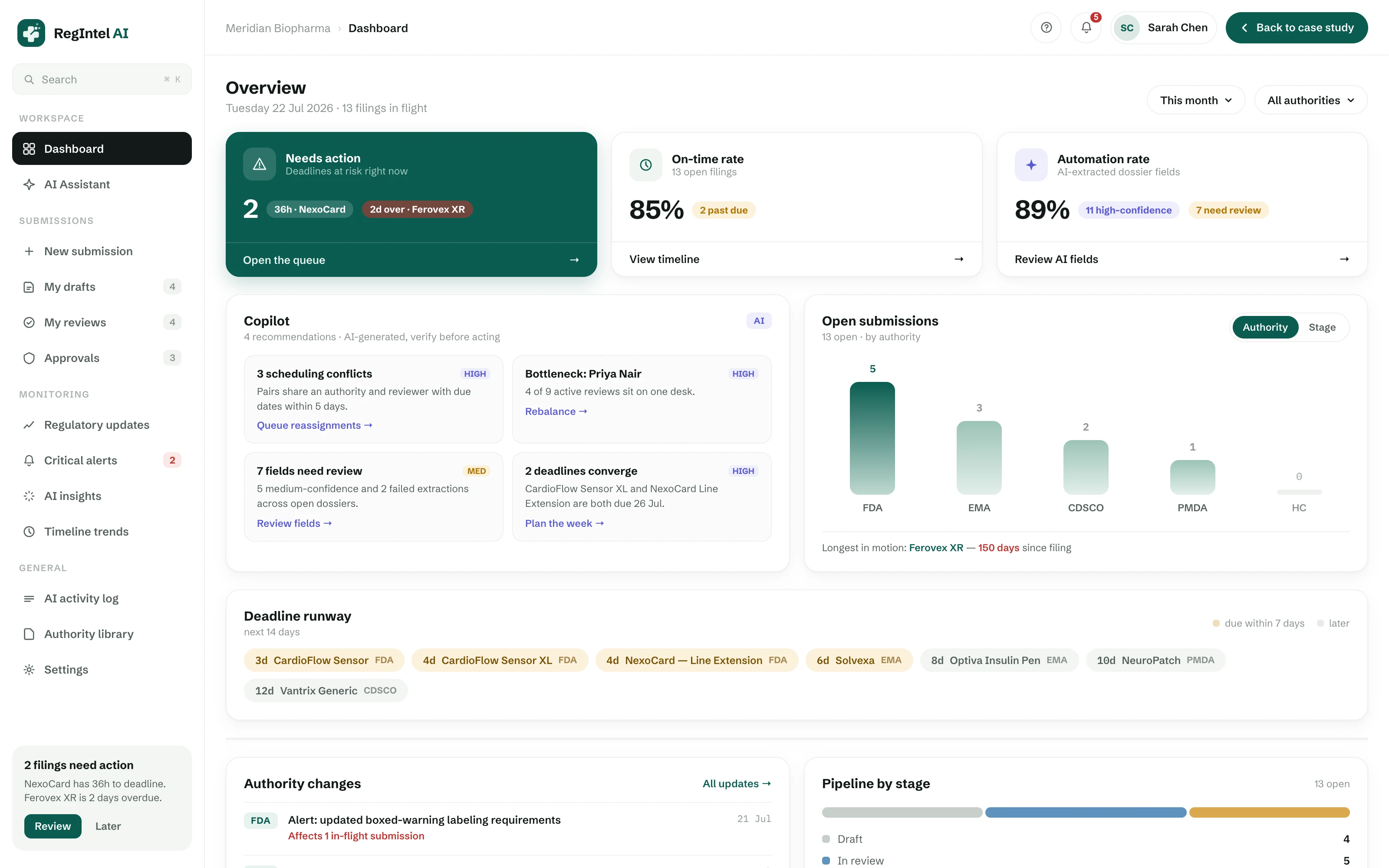
Landing view
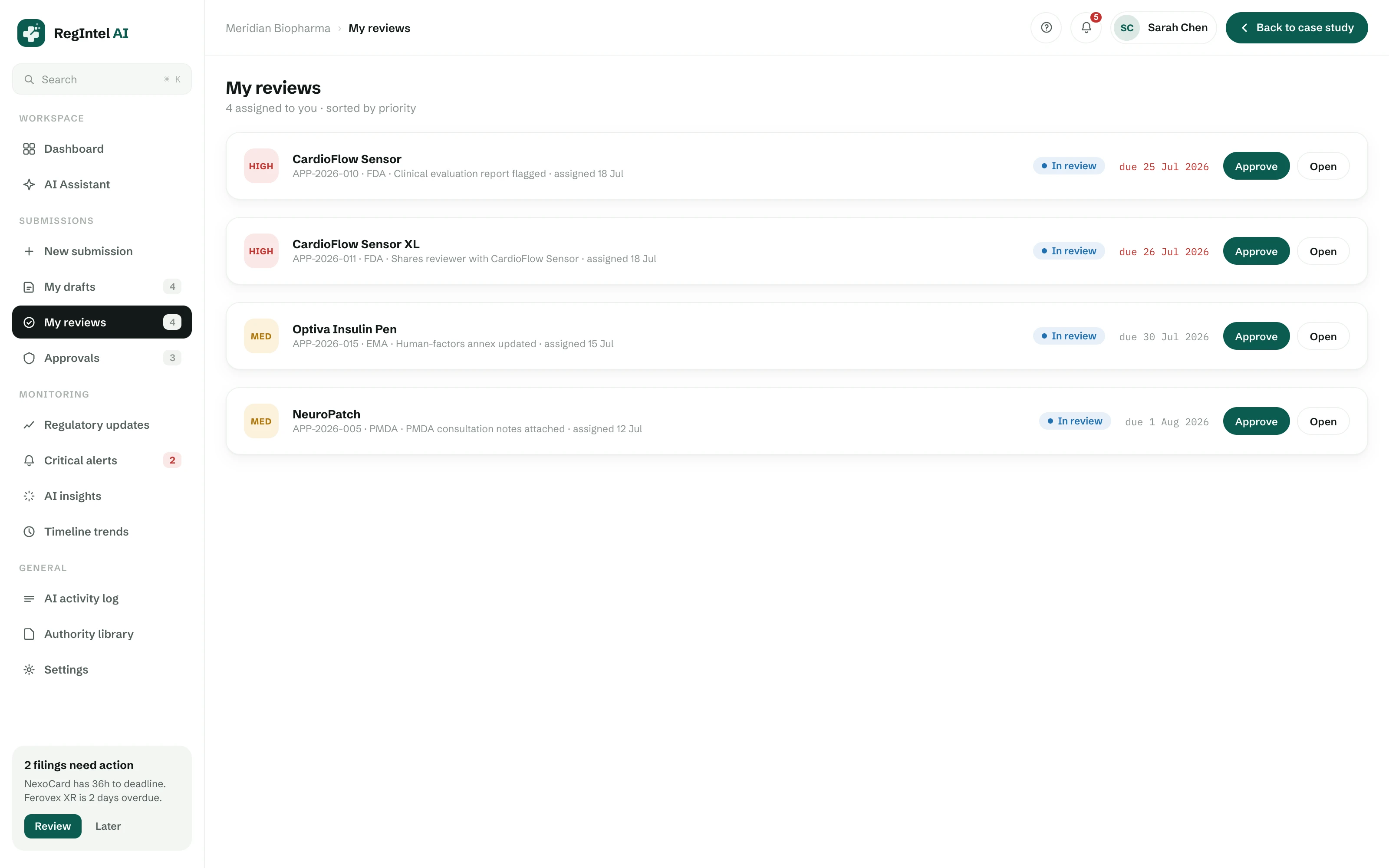
The daily grind
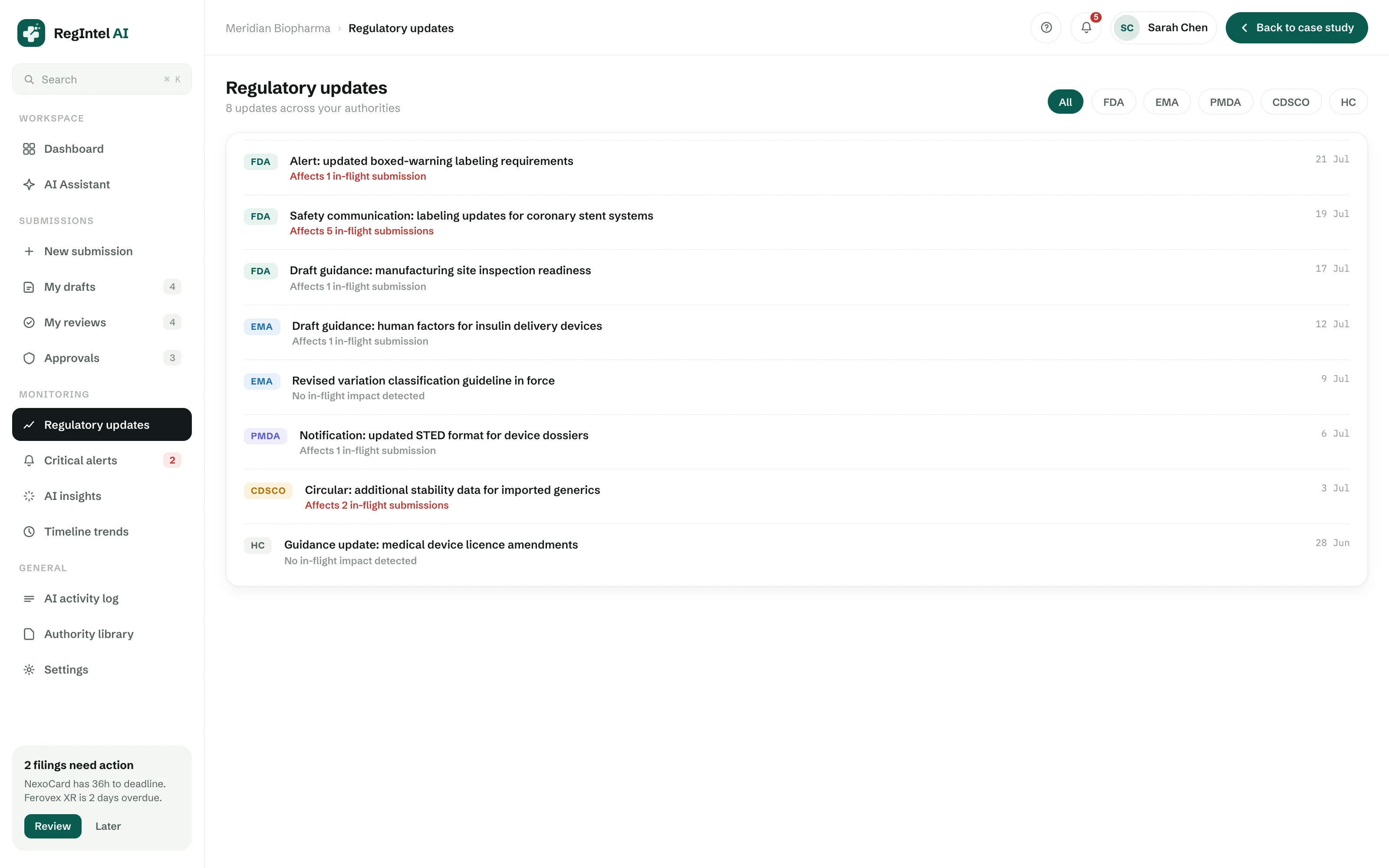
Early warning
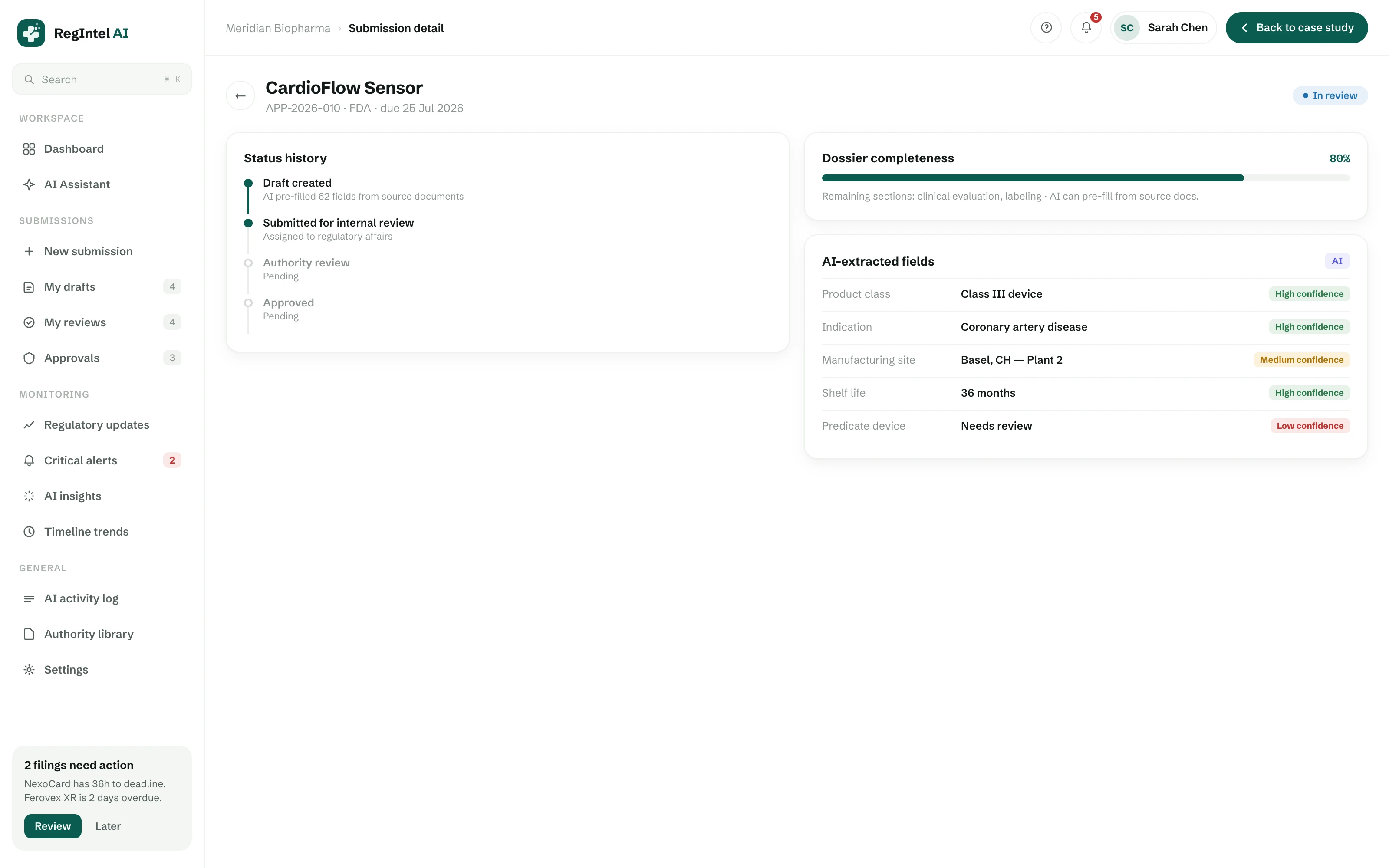
Detail layer
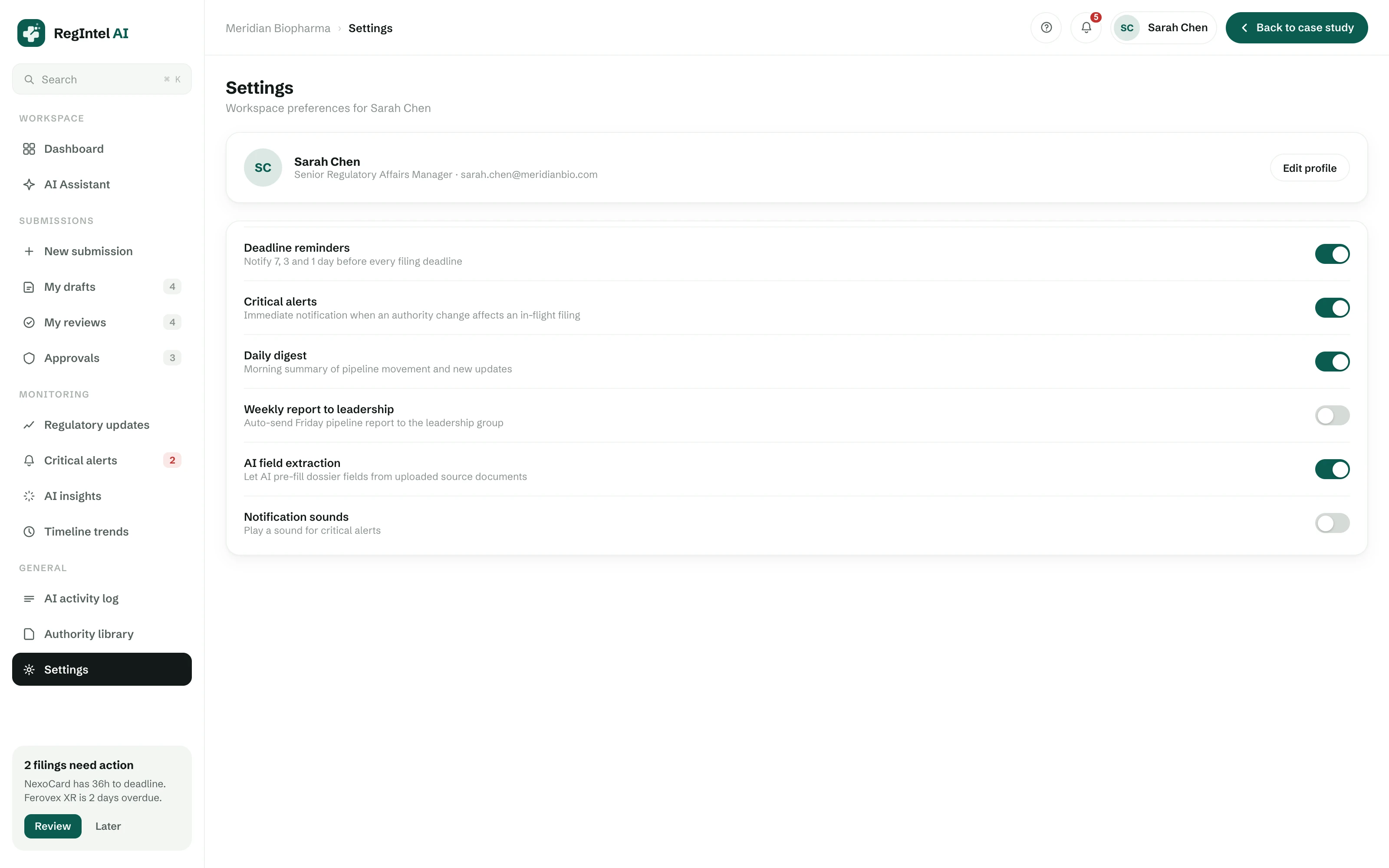
Control room
The metrics below are the outcomes reported in the RegIntel case study.
Moderated sessions with RA managers, reviewers and QA leads — each round measured against the previous iteration, so improvement was proven, not assumed.
Round 1 failed on AI trust, not navigation. Adding reason, source and confidence to every suggestion moved acceptance from 12% to 73%.
Round 3 · final scorecard Tasks tested
Find the submission nearest its deadline 98% · 0.6m
Triage an FDA guidance change to affected filings 93% · 2.4m
Apply, then revert, an AI reassignment 95% · 1.1m
Trace who approved a document, and why 97% · 0.8m
"The deadline found me. Eleven years of this job and it's the first time the tool warned me before I went looking." — RA Manager, round 3
Up from 58% in round 1
Excellent · benchmark 68
Up from 12% in round 1
↓55% Submission prep time Dossier assembly measured across the first two post-launch quarters
↓90% Missed deadlines From two per quarter to a near-miss caught two weeks early
73% AI acceptance rate High-confidence suggestions accepted — because each shows its receipts
↓65% Audit prep time The activity log answered every request in the first inspection
The testing section details the usability results behind the redesign.
AI · TRUST Trust is earned per-action, not per-model Accuracy statistics convinced nobody. Reason, source, confidence and undo on every suggestion did. Trust in AI is a UI property.
HIERARCHY · SORTING Deadlines are the spine of the product Once every list sorted by deadline risk, the product answered the question users actually had. Sequencing beat adding.
SYSTEM · STATUS Color alone is never meaning Color + dot + label began as accessibility and became the strongest consistency device — one status vocabulary, fourteen screens.
COMPLIANCE · ADOPTION Auditability is a feature, not paperwork Designing the activity log as a first-class screen is what let the AI ship at all. In regulated industries, undo is the adoption strategy.
Explore the regulatory workspace: dashboard, submissions, monitoring, reviews, and AI activity. Try the product after seeing the design decisions behind it.
LET’S TALK
I'm open to Senior Product Design roles in Dubai — AI platforms, enterprise products, and agentic experiences.